Aug 082010

Pavlov: we fed the chicken on the opposite side of the road each day at 4pm until the chicken’s autonomic system actually began causing the chicken to cross the road at 4 pm without even questioning the “why.”

B.F. Skinner: on prior occasions when the chicken voluntarily crossed the road, this behavior was followed immediately by a reinforcing consequence.

Cesar Milan: I bullied, chased, poked, and intimidated the chicken until it raced across the road, because I am a strong leader…

Barbara Woodhouse: You just say, “Walkies” with the right accent and place a crumpet on the other side of the road…

Karen Pryor: by associating R+ with road crossing and P+ with standing still, with a VR schedule, and offering a reward in keeping with the Premack principle, we increased the intensity and frequency of the road crossing behavior.

Victoria Stilwell:  Who cares?? The important question is,  do these pants make me bumm look fat?

Bill Koehler: a few well-timed pops on the choke chain and the chicken was happy to cross the road.

Nicholas Dodman: I gave the chicken fluoxetine, sertraline, paroxetine, carbamazepine, and azapirone and then it was happy to cross the road.

Patti Ruzzo: I crossed the road, pausing every step to spit a treat out of my mouth like a human pez dispenser, and the chicken followed along catching the treats.

Electric Collar Advocate: whenever the chicken does not cross the road I give it an electric shock. But do not worry, the shock is no more than you would feel if you walked on a carpet wearing socks and it does not bother the chicken at all. The feathers standing up and the smell of burning flesh mean nothing. In fact, they are happier having nice clear communication than they would be otherwise.

Yuppie: chickens are just like little people in feather jackets, and if you love them and give them diamonds and feel sorry for them all the time, they will be happy to cross the road for you.

Paris Hilton: Because I put it in a Gucci bag and carried it…

Shelter director: Any chickens that do not cross the road will be euthanized for their own good, and the others we will “adopt” out tomorrow for only $200 each. Please send us money so we can keep doing more of this important work!

HSUS member: I do not know anything about animals, I have never been around animals and am not really fond of animals, but we passed a law mandating that chickens be kept without cages because animals belong only in the wild and cannot be happy coexisting with man, so now they are walking wherever they want.

PETA member: chickens have the right to live in world without roads. Any chicken that lives within a hundred miles of a road is suffering an inhumane existence and might eventually be hit by a car so we should kill it today to ensure that it does not die tomorrow.

  • Share/Bookmark
Apr 302010

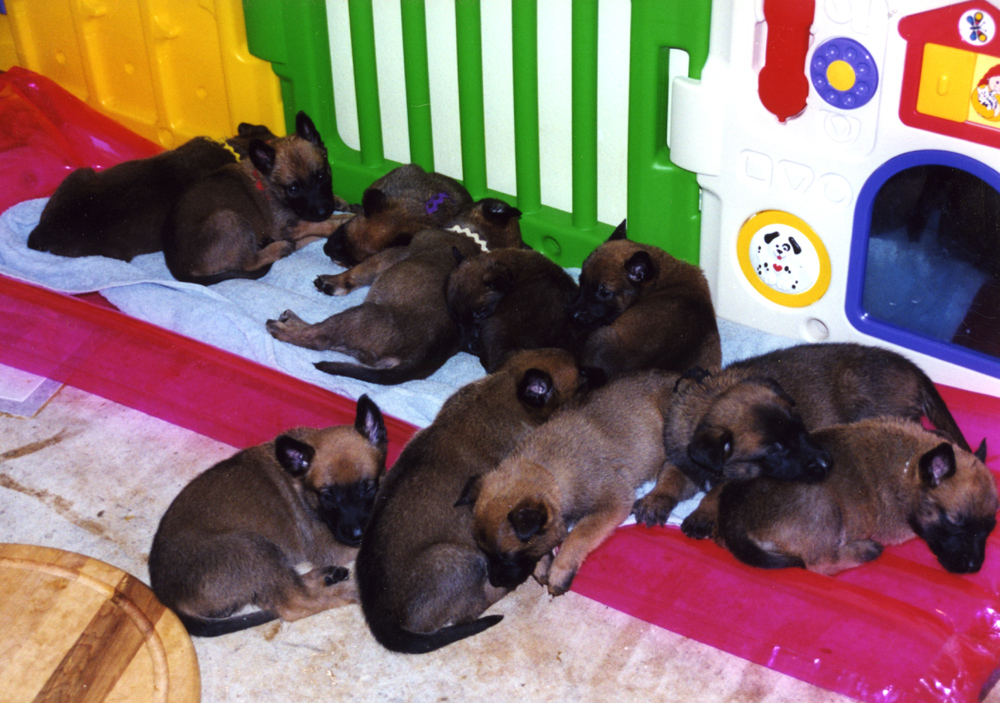
It is difficult to believe that ten years have passed since we raised the “Litter of the Law.”

We put together video and photos of a few highlights of their lives so far, and thought some of you might enjoy seeing it.  It is simultaneously too long and too short, as it is difficult to capture ten years of the lives of eleven puppies without making a very, very long movie…

  • Share/Bookmark
Apr 212010

"We want more Americans to know about the millions of shelter pets that need good homes."

These new stamps are beautiful and encourage adoption. But I will not purchase them.

I do not want to be counted as even tacitly supporting the anti-animal agenda of the HSUS and Ms. DeGeneres who sponsored these stamps, but even more, I believe these stamps will have a genuinely harmful impact on animals.  Let me explain:

Twenty years ago I would have enthusiastically supported stamps encouraging adoption.  Since then, HSUS, PETA, ASPCA, and others who seek to eliminate all pets have been waging a very effective propaganda campaign to manufacture the illusion that adoption and breeding are contrary. They have been so persuasive in creating the societal notion that rescue is moral and responsibly purchasing a well-bred pet is immoral, that I am no longer comfortable going along with propaganda that reinforces this misconception. While I continue to advocate for adoption/rescue in some situations, I now advocate primarily for responsible owners doing research and supporting good breeders. (Note: good is not synonymous with purebred)  It is a simple truth that if you make it impossible for good breeders to survive, all that is left are the “bad” breeders.  That is not a good thing, and the next step is to eliminate the bad breeders, and then you have eliminated pets.  In this vein, I believe these stamps will contribute to the already overwhelming anti-breeder-pro-rescue-sentiment in this country, and that directly hurts animals.

There is a reality in which people breed animals because they are too lazy to avoid it, to make a buck, or to show their kids the miracle of birth.  A reality in which people acquire dogs and casually dump them when they become inconvenient, or neglect them in their yard, or abandon them. Rescue is a vital component of this reality.

Just as real, however, is the world in which serious breeders devote incredible amounts of energy, knowledge, and money to improving their chosen breed. They screen homes carefully, take back animals, fund research, and are deeply dedicated. Their animals are generally sold to owners who are similarly responsible and committed. Within this group are most people within the fancy, most serious competitors in animal activities, even the people who think their pets are surrogate children. These are people for whom animals matter profoundly and whose lives revolve to a large degree around animals. Not only do the people in this reality not generally contribute to the shelter population, they actively adopt or rehabilitate pets and work to educate the casual public. Their work protects not only the animals of the future, but the owners as well. When we persuade people that the place to get a pet is from a responsible breeder, then we can make real inroads into eliminating irresponsible breeders, and by extension most animals in rescue, because there will be no demand for their puppies.

If every home in America WANTS to “rescue” a puppy from the shelter, we have destroyed the market for well-bred dogs and created demand for precisely that which we ostensibly want to eradicate.  We need to eliminate the bad breeders, not the good ones, and making shelters the only politically correct place to acquire a dog does just the opposite.

The problem is that the “Don’t Breed or Buy While Shelter Animals Die” propaganda ignores this dichotomy entirely. Not only ignores it, but seeks to destroy all breeders by painting them with the same destructive brush.  And they have been VERY effective. Most non-animal people are absolutely certain that there is a huge pet overpopulation problem caused by the fact that breeders are greedy and evil, and that the solution is to boycott breeders, pass mandatory spay/neuter and and number limit laws, only adopt pets, and send money to HSUS. This message is already being  shouted so loudly that the vital reality of responsible breeding is being lost in the noise.

We do not need to increase awareness of shelter animals, everyone is aware.  We need to increase awareness of the remarkable people who are doing a truly great job preserving and nurturing healthy happy dogs and who are being destroyed by the same propaganda machine that is producing these stamps.

  • Share/Bookmark
Dec 282009

riotleapoffinnertube

You have probably read the “Rainbow Bridge,” or one of its several variations.  Each of these is a lovely story about where your pets go after death—a beautiful place, full of all the things they love and absent any possible source of discomfort, where someday we will rejoin all of our past friends and romp in beautiful meadows where all animals love and help one another.

I do not want to be a curmudgeon, or diminish anyone’s delight in a parable; however, for me, such saccharine tales insult and trivialize reality—as though the wonder we share with our animals while they are alive is somehow not enough and we need to make up a better story; as though we need to turn our animals into vapid and immortal Disney characters in order to love them rather than simply loving them as they are.

Whatever happens to them when they die, I cannot know or alter, so I focus on what I can control—ensuring that their time in my reality is the best it can be.

One of the greatest lessons our pets can teach us is to live in the moment.  It is amazing how little my dogs seem to worry about the mortgage, or taxes, or growing old, or death.

Want your dog to have a perfect day at the beach? Take him.  Want him to bask in front of the fireplace with a perfect toy to chew on?  Make it happen.  Take him to the snow, go on a hike, teach him a new trick, rub his belly. You get at most a few thousand days with your dog, so make them great.  Your dog has simple wants, and it is amazing how many of them you can make come true with just a little effort, so make his life wonderful. Give him beautiful meadows in life, not in death.

I imagine some of my readers will protest, “the Rainbow Bridge makes me feel better, there is no harm…” and that is fine, you are obviously welcome to believe in whatever fairytales you find comforting, and I know many people have found solace in imagining their animals at the Rainbow Bridge.  I for one am going to delight in the real living animals that I find magical enough. And when they are gone, I will grieve, but ultimately I will remember the lifetime we shared, and that will be more than enough to fill me with joy.

  • Share/Bookmark
Dec 252009

card2test

  • Share/Bookmark
Aug 172009

Every year Loki and I spent a week at the county Fair, doing demos and talking to people about dog training. I certainly enjoyed these days, but really we went because Loki loved it. Twelve hours a day of doing his favorite tricks and getting applause, getting loved and petted by thousands of people, eating steak burgers and ice creapillowsm, and generally being the center of attention was a perfect day for Loki, so of course we went… Every few hours Loki would go into his crate for a quick nap. He loved this also—for a border collie, Loki was quite lazy, and a good nap was among his favorite things. One day I was sitting there next to Loki’s crate when a woman came running up calling me a heartless bastard. I looked around to see what she meant, and after a moment realized she was talking about Loki, lying there on a soft bed in a crate trying to sleep but somewhat disturbed by her yelling… I reached down and opened the crate door. I thought it was a grand gesture that conveyed everything I was thinking. She got even angrier and told me that I had broken his spirit and he was too afraid to come out of the cage. So I called him out and he cheerily did a few tricks; I tossed the Frisbee for him a few times, gave him the last bite of my ice cream (hey, it was the Fair!), kissed him on the head, and sent him back into his crate to finish his nap…

A few weeks later I was working on a photo-shoot at a lovely park in Beverly Hills on a warm day with several puppies. The shot involved them playing with a boy in the shade, and they had a great time playing and tugging and occasionally licking baby food off the boy. The whole time there was a fan blowing on them, and any time one seemed tired we rotated it out and used another puppy. Between shots we went back and sat in the very comfortable 16’ x 8’ air-conditioned back of our truck. I put pairs of two puppies each into three extra-large crates together to let them play a little and relax. A woman came over and asked if she could look at the puppies, and I said sure. She came into the truck, looked at them and said, “Awwww, you poor babies…” So I looked to see what was wrong! They were rolling around on cushy beds, at 65F, with water and bowls of ice with toys and chewies. They were obviously ecstatic, as opposed to all the people who were standing outside in the heat. So I asked her what made them poor babies, and she said, “They are in a cage.”

My initial instinct is to dismiss such people as crazy—ignorant and irrational people who are so married to their preconceptions that they are unable to objectively evaluate what is immediately obvious to anyone who takes a minute to observe and think; people who ardently call themselves animal lovers, and undoubtedly love the idea of animals, but are ignorant of the needs and desires of actual animals. However, so many people seem to feel this way about crates that I genuinely try to understand their perspective. These people do not see what I see when they look at a dog in a crate. They cannot see past the bars—they do not see if the animal is happy, healthy, relaxed, or content. They do not imagine the other 90% of the animal’s existence, out of the crate, having a rich and full life. They do not see that the animal is able to have a wonderful adventure today and not be left home because of the crate. They do not see the safety afforded by the crate. They do not imagine that the dog wants to be lying down right now and that it prefers lying in the comfort and security of a familiar man-made den.

Crates are tools—neither good nor bad—they have no innate value. Their value derives solely from how they are used.

Of course, the people who think crates are inherently cruel are unlikely to be reading this blog; nonetheless, I thought I would review the primary situations in which a crate is a great tool and the primary situations in which a crate is deleterious:

When Crates are Ideal

Safety in vehicles: in a vehicle, a crate is the canine equivalent of a child safety seat. Sure, it may look like you have strapped the child into a torture device, and yes you have temporarily restricted their personal freedom, but it is essential in order to transport them safely. We all understand that good parents take their children places and use safety seats to protect them, similarly responsible pet owners know that they need to take their pets places in order to give them rich, full, fun lives, and that crates protect them while travelling. Crates keep them from being thrown during impact, from interfering with the driver, and from escaping into the street if there is an accident.

Safety at home: think about a crib. Understanding that an infant can quickly hurt itself by eating or touching the wrong thing, we all recognize cribs as a tool of responsible parenting, and would be shocked to learn of a parent who did NOT use a crib—who left her infant to wander the house while mom took a shower or napped or whatever. Nobody sees a crib as cruel when used appropriately—the child is going to nap or play in a small area much of the day naturally, and providing bars that keep the child safe is humane and advisable. Countless dogs die every year from eating toxins, chewing electric cords, getting out, etc. And many of these dogs had been left loose many times previously and one day they did something they had never done before and were seriously injured or killed. Other dogs are left outside and are stolen, poisoned, or escape.

Training: many undesirable habits can be challenging to break if you cannot always be present to enforce the rules, but if you can use a crate to prevent the dog from rehearsing the behavior except when you are present to train, you can fix most of these problems very quickly. Millions of dogs end up at the pound each year, and are eventually killed, because of simple behavioral issues, many of which could have been fixed in a few weeks of the owners had properly used a crate.

When Crates are Detrimental

Too long: the obvious failure of crates lies in using them for too many hours per day, too many consecutive hours, etc. Unfortunately, some people really only want a dog for a few hours each week, and they use crates to essentially “get rid” of the dog for all the other hours. The dog gets inadequate exercise, and ends up bored and lonely and there is little relationship because the dog is always in a crate. However, this is a delicate topic, because many people “feel” that a dog is in a crate too long without thinking about how many hours the dog would chose to lounge around in one spot if it had the choice. It is somewhat amazing how many hours each day an average dog is content to lie around if the other hours are rich and full. This balance is different for each individual, so assessing how much crate time is “too much” requires paying close attention to the dog and listening to what he wants.

Avoiding issues: sometime people use crates to avoid behavioral issues that could be resolved with a little effort, but instead of making the effort people just avoid dealing with them by crating their dog all the time and never letting the issues arise. In most situations, crates should be used to help improve the issues, not merely to avoid them.

One of the most significant problems facing responsible animal owners these days is the willingness of “animal lovers” to make value judgments based on assumptions. If you really care about animals, you must evaluate their well-being based on their condition and attitude, not their mode of transport. I wonder how many of the people feeling sorry for my healthy and happy dog delighting in doing tricks at the Fair have an obese and untrained dog at home, bored out of its mind sitting in the same 2500 square foot crate for twenty-three hours of every day of its life.

  • Share/Bookmark
Jan 282009

For many years, Animal Planet was like a dream come true.  I could hardly believe that anyone had made a network just for us!  There were experts representing a wide range of views, some I found brilliant, others completely misguided, but they were all interesting: serious and thoughtful people sharing information and ideas about animals.   A huge portion of the programming assumed the viewers were intelligent and reasonably competent, and virtually all of the programming was animal positive.  Occasionally the productions were slick, but almost always they were honest and interesting.

As time went by and APL sought to attract a broader audience, several things changed:

1.       They stopped making shows for a knowledgeable audience. They needed to add shows for novice trainers, but why abandon programming that catered to advanced trainers? They seem even to have decided that a large portion of their programming needed to appeal to non-animal people.  Because lots of them are going to watch Animal Planet?

2.       They focused on the negative almost exclusively.  “If it bleeds it leads” has never been truer than on APL.  They have more shows about animal abuse than almost anything else.  I can go sit down almost any time of the day or night and watch some officer buts some jerk who is starving/abusing/neglecting his animals.  This is not animal programming—it is jerk TV.  Yes, there are horrible people in the world who do horrible things to animals, but do we really need hour after hour focusing on them? Almost as often as animal abuse shows are animal attack shows either showing captive animals attacking people or hours and hours of predators killing prey.

3.       They became extremely political and lopsided—essentially a propaganda machine for the animal rights perspective.  Captivity is portrayed as “bad” on most of their programs, with very little effort to portray both sides or even an objective middle ground.

4.       They traded information for drama. Genuinely “good” animal training is rarely dramatic.  Truly gifted animal trainers are quiet effective leaders who use patience and gentle manipulation to create opportunities for animals to succeed, avoiding conflict, reading animals and reacting before most can even tell something is amiss. Drama arises only when we make stupid mistakes, poor decisions, or are in a hurry. I have spent hundreds of hours working with authentically talented animal experts working with a huge array of animals, and I can hardly recall a single moment that would have made good television. Most of the time there is very little visible action, only steady, quiet results.  APL does not trust that the information on its own is interesting, so they create drama and conflict and cool music, and we get lots of fluff but no substance.  Too bad, because the real APL audience is knowledgeable enough and interested enough that if you would just provide quality information they would love to watch. 

5.       They do not respect animal people.  In the popular media I understand the desire to portray every animal lover as an eccentric nut who does not bathe, urinates on himself, dresses her dog in a tutu, is covered in hair, caries poop around in a fanny pack, is completely disconnected from normal human society, or otherwise amuses an average audience.  But APL??  Come on guys, these are your viewers. 

6.       Whenever they do have a training show on, the training is completely simple or is truncated to the point of meaninglessness. 

7.       They became astonishingly anthropocentric—every wildlife show is filled with value judgments as though predators are evil.

Sadly, I almost never watch APL anymore.  There are a few good animal or training shows on TV, but they are on other networks…

  • Share/Bookmark