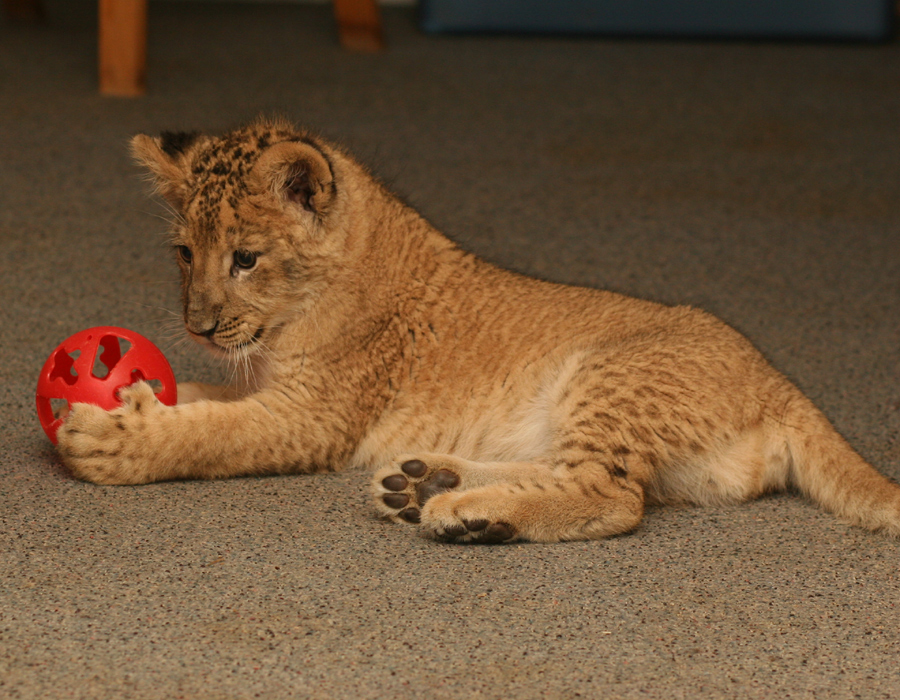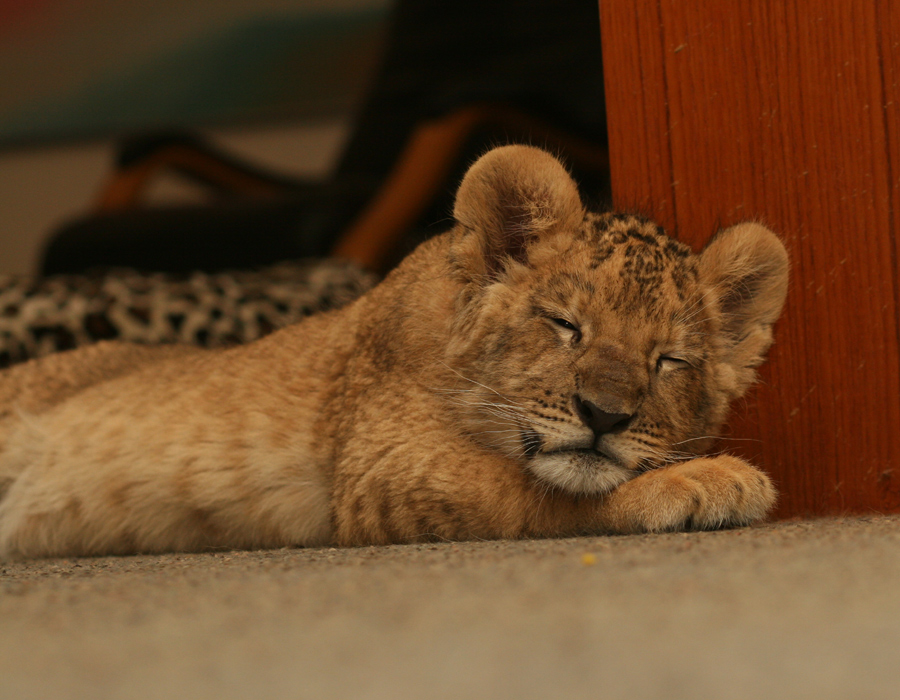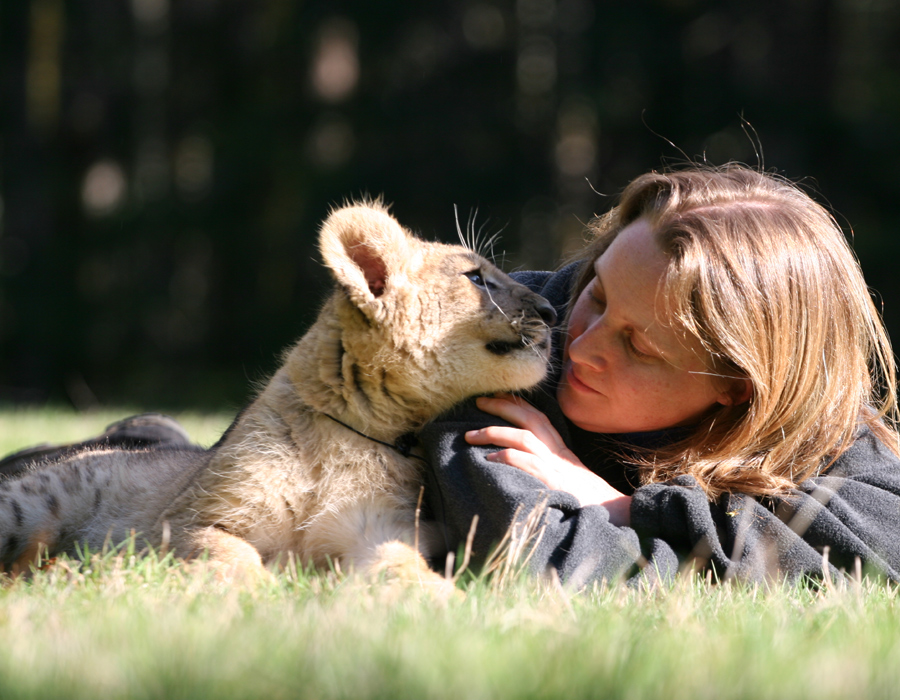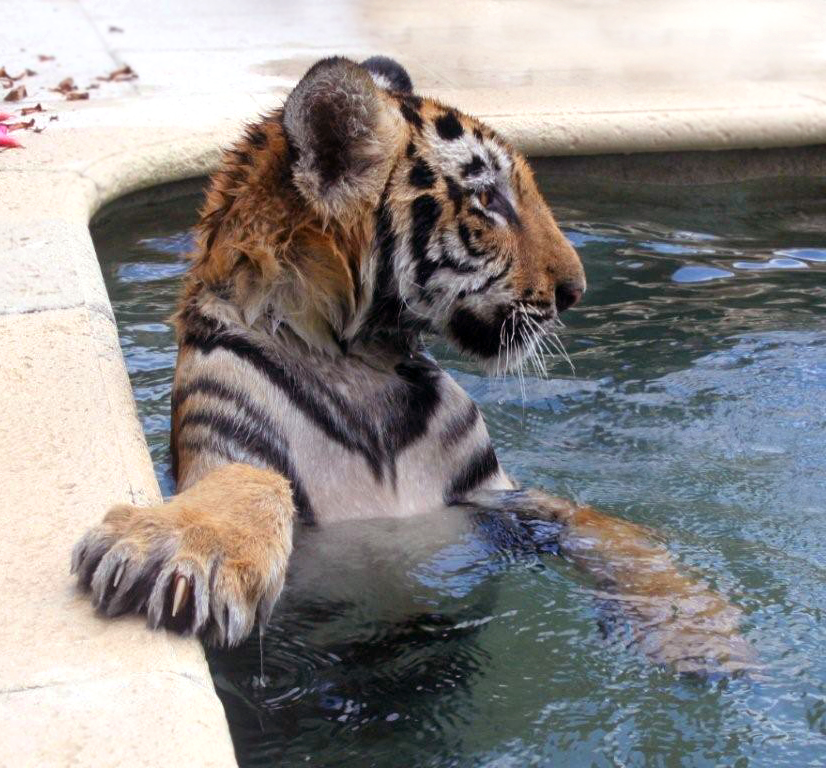
For those who met Titan while he was staying with us, or watched his videos on this blog, here is a picture of him in his new home. He is doing great and has remained the sweetest and happiest tiger imaginable. He has a nice enclosure and a great pond, but nothing beats a nice swim in the pool on a warm summer day:
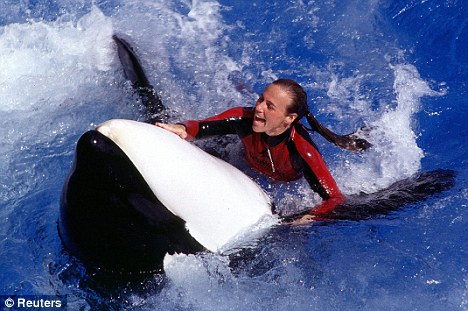
On February 24, 2010 in SeaWorld’s Shamu Stadium in Orlando, Florida, animal trainer Dawn Brancheau was pulled under the water by an orca. A few minutes later, Dawn was dead. Subsequent discussion in the media and around the Net has focused on the keeping of orcas and the dangers of working with powerful predators.
Profoundly missing in this discussion is Dawn’s voice.
I cannot speak for Dawn, but I can share with you the professional animal trainers’ perspective. You see, we all understand a common truth, and when an event like this occurs, we talk late into the night trying to figure out how we can effectively share that truth with others – how we can explain why, as Roy Horn was slipping from consciousness in the jaws of Mantecore the tiger during a Las Vegas show, he was saying over and over, “Please don’t hurt the cat… .”
Animal training is not a job, not a hobby, not an interest. It is an all-consuming passion. Those of us who devote our lives to working with animals love what we do beyond reason. We work 365 days a year, and when we are not working with animals, we are playing with them. We forego vacations, families, nice clothes, tidy homes, and most social activities to spend our lives with animals. We spend countless hours talking about how to care for animals, we get up every few hours to bottle-feed baby creatures, we spend all our money on animal care, and we use most of the rooms in our homes for something animal related. We are joyously consumed by our chosen path, and when an animal causes one of us injury or death we are sad, but hold no ill-will towards the animal. Let me explain.
We work with animals – not Disney characters, or humans wearing fur costumes – but real animals with real teeth and claws and immense power who behave according to their animal natures. We know that our chosen vocation is extremely safe based on the number of people harmed, but we also recognize that it entails real risk. We believe that life is an adventure we cannot authentically live solely by avoiding those things that might result in failure, injury, or death. Some people climb mountains, race cars, surf, pilot airplanes, luge, or share their lives with animals, and each of these journeys poses risks, although in truth people are far likelier to die in traffic accidents or childbirth than in any of these more dramatic undertakings. Sitting at home on a couch may indeed be a safer choice, but living a rich and full life and owning our own choices and their consequences are worth a little risk.
When accidents occur, people often want to examine the details and motivations of an animal’s behavior to understand exactly what happened and why. Careful investigation and analysis is a valuable process to allow us to improve our techniques and avoid needless future accidents, but in truth we can rarely know precisely why an animal behaved in a certain way. In a very real sense, however, such speculative detail does not matter: whether the animals were attacking, trying to protect themselves, sexually aroused, responding in annoyance to excessive pressure or fear, or some other miscue, the stark truth is that any of these circumstances could have arisen with similar outcomes. Many animals are vastly more powerful than humans: given sufficient time, wherever humans and animals interact, injuries may occur.
People who argue against working with animals often assert that certain animals are “unpredictable,” a completely erroneous claim. Each species, and each individual animal, is endowed with a well-established range of behaviors and rarely acts in conflict to these. Understanding and correctly predicting animal behavior is among the most basic challenges and responsibilities of any trainer.
Animals are often held accountable for their actions, a profoundly wrong conclusion: animals are not subject to “blame”: they always and simply act as animals, and people are responsible for minimizing situations in which harm might come to anyone.
Underlying the common reaction to traumatic animal incidents lurks a contemporary human expectation that the world should be “risk-free.” As human enterprise has relentlessly expanded, we have paved, denuded, and sanitized huge portions of the planet. In virtually every populated environment, we have effectively eliminated any predator that might pursue us. We fully expect handrails and padding and signs to protect us at all times. But nature cannot and should not be completely tamed. When we venture into the wilderness, or bring a piece of the wilderness into our world, we find that bears, wasps, mountains, skunks, waves, tigers, and orcas do not respect our notion of sovereignty and will behave as they have behaved since time immemorial. Innate animal behavior is not amenable to human moralizing: it is neither good nor bad. It is simply a truth that we must understand if we wish to interact with the natural world. Each day, millions of animals safely coexist with man. Many visit schools, perform tricks, and lounge around. For hundreds of shows, Roy’s tigers reliably came on stage and performed perfectly. Such numberless days of productive and enriching interaction cannot be forgotten as we scrutinize the day someone is injured.
Why is it that when people die in automobile accidents we do not seek to ban cars? Or when people die on mountains we do not seek to outlaw mountain climbing; but whenever someone is injured by an animal there is such an outcry? There are four reasons:
1. Animal attacks are rare, which makes them dramatic and newsworthy.
2. Few people actually work with animals or experience them firsthand: and it is much easier to blame, condemn, and legislate out of existence something you do not understand and that does not directly affect you.
3. Over millions of years of evolution, hominids developed a powerful innate fear of being eaten.
4. Human society is plagued by uninformed zealots always ready to twist any event to serve their purpose:
The loudest voices heard in the wake of traumatic animal incidents are those of Animal Rights advocates who aspire to outlaw all animal ownership and who seize any tragedy as an opportunity to chant their mindless rhetoric: “these animals ‘belong’ in the wild. This death proves it…” No. By now every thoughtful reader should realize this is simply hogwash. Nearly every species of animal can be superbly maintained in captivity where they are enabled to live rich lives that are longer and more comfortable than in the wild. We can learn from such creatures and enjoy them and share them with millions of people – especially young people – who will grow to care about the natural world. These animals are not demeaned or mistreated and are not yearning for freedom. They have plenty of space, excellent nutrition and fabulous lives. The only people who believe these animals have bad lives are people who have little experience with them and are forming their opinions based on uninformed sentimentality–people with genuine expertise quickly learn that these animals have excellent lives. The accidental death of a person who devoted herself to the well-being of captive orcas does not prove that orcas cannot be kept humanely, and the propagandists at PETA should be profoundly ashamed for using trainer Dawn Brancheau’s death to preach their own agenda, an agenda rejected and reviled by every thoughtful animal trainer.
As a professional working every day with powerful predators, I do not fear for my life; rather, I fear that should I be injured or killed by an animal, people who espouse “rights” but care nothing for actual animals will use such an event to harm the very animals I have spent my life cherishing.
We love these animals completely, even when their nature does not accommodate human society, and even when their actions harm us. They share their worlds with us, and in doing so bring immeasurable joy to our lives. We are afraid, not of them, but for them. We want them to be preserved in the wild and in captivity by skilled and dedicated experts, and we want people to stop being enraged when they behave like animals.
All the lives of all the animal trainers ever lost working with animals is a number far smaller than the number of children who starved to death while you were reading this article. Working with animals is safe and immeasurably beneficial for the humans and animals. If you really want to help someone, focus on providing food and healthcare to the millions of people who absolutely will perish without your help, and leave those of us who love animals to make our own well-informed decisions about how to balance our safety with our passions.
I am heading outside now to play with my beloved animal friends. I may make a mistake, and I may die. If so, please do not mourn the manner of my death. Do not blame the animal. Do not imagine that I was an idiot, or naively unaware of what could happen, or thought myself invincible or protected by the animals’ love. It is the life and death I chose, and lived without regret. A lifetime full of joy, passion, and wonder shared with many magnificent animals whose lives were also full of joy. Whenever and however I die, I have been blessed to live my dream.
Last week, arguing that orcas should not be kept in captivity, PETA president Ingrid Newkirk lamented that captive orcas are “swimming in their own diluted urine.” A perfect metaphor for the insanity of Animal Rights: apparently she believes that wild orcas all use a giant toilet where they flush their urine away…
“Don’t be silly,” some may say, “in the ocean there is lots of room for the urine to dissipate whereas an aquarium is much smaller.” This is emblematic of the sort of “facts-be-damned” thinking PETA endorses. Simple truth: the water in any U.S. orca habitat is orders of magnitude cleaner than the water in the ocean. It is filtered, UV sterilized, chemically balanced, and checked several times a day.
If you believe orca’s should not have to swim in dirty water containing dilute urine, by all means get them the heck out of the filthy ocean and into a clean aquarium…
In the same interview, Bob Barker explained that the enclosures orcas are kept in are equivalent to putting a human in a bathtub. Really? When is the last time you were able to swim at full speed in your bathtub? Dive many times your height below the water and then leap into the air more than twice your height? Maybe in Bob Barker’s bathtub… Simple truth: orcas are kept in habitats costing tens of millions of dollars, their diets are superlative, their exercise and enrichment plans among the best in the world, and the irrefutable reality is that they live longer in captivity than in the wild. Cetologists and trainers at Sea World have been instrumental in protecting these animals in the wild and in captivity, and have provided more knowledge and funding to help orcas than almost anyone else in the world while also fostering interest and passion for these animals in tens of millions of children. Bravo!
Mr. Barker also spoke about how “demeaning” it is for an animal to have to perform tricks for the entertainment of humans. This is absurd. An animal learns a behavior and it does that behavior and receives praise and reward. This exercises their bodies and their minds, and is in no way demeaning to the animal. Animals make no value judgments about whether doing a flip befits their social standing—they simply do the behavior and have a great time. It is a game, one that they play in the wild as well, and one they can stop anytime they want. Perhaps Mr. Barker is simply projecting his life onto the animals—he DID spend his life performing in front of the masses in exchange for a great deal of money which he now seems determined to spend ruining the lives of as many animals as possible.
HSUS is now lobbying to have Tilikum the orca released to the wild. They want to repeat the Keiko adventure which generated many donations. You remember Keiko, the orca who was taken at great expense from his nice Oregon enclosure where he was healthy and happy and turned loose into the wild where he pined away for months following boats and swimming into bays looking for any friend who would feed him fish and rub his belly as he remembered from his days in captivity. Until he finally died with pneumonia, starving and lonely. Yes, let’s do that again! Because animals deserve to be in the wild…
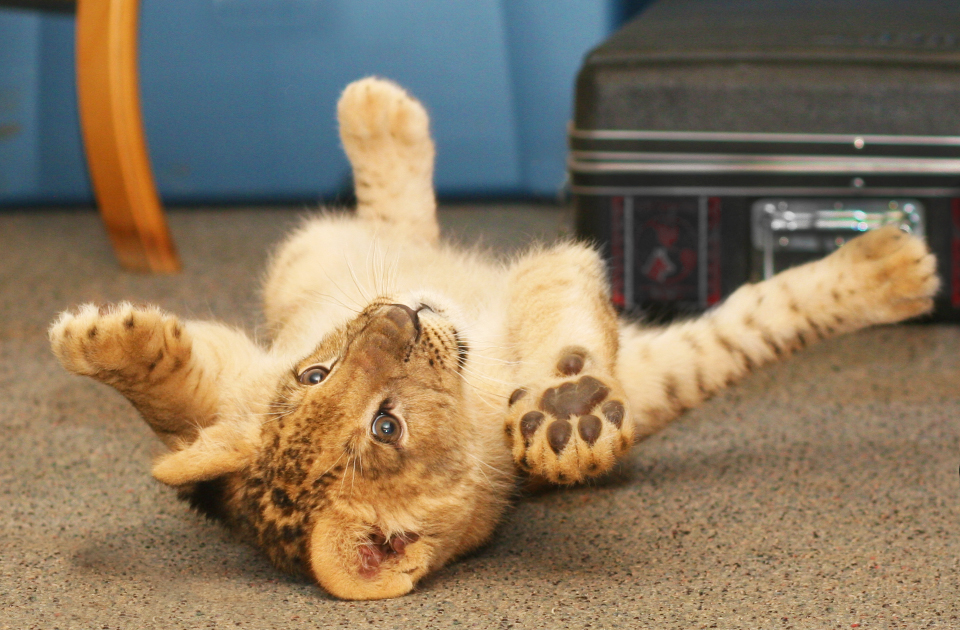
We have been caring for a young Bengal tiger named Titan. He was 8 weeks old and 15 pounds when he arrived, and around 22 pounds eight days later. He has around 500 pounds still to gain. He is on his way to a new and exciting life, and is here for some additional socialization. We are quite fortunate to have some wonderful colleagues who sometimes send animals here which allows us to keep learning and experiencing new individuals, and benefits the animals by exposing them to new experiences with trainers who are good at showing them that the world is a wonderful place. While with us, Titan will get to meet a wide variety of “other” animals and have different experiences. One aspect of training animals for film is that a wide variety of animals either live here or have visited, so all of our animals are quite welcoming towards visiting creatures. Last summer we had a baby camel in the kitchen and I opened the door to let the dogs say hello, and they walked right past her as though a camel in the kitchen was utterly expected…
I thought it might be interesting to share a few observations and images of his stay. Of course, this post will be mostly video since I am pretty sure most people would rather watch a tiger than read my observations!
Anytime you are raising an animal that will grow up to be easily capable of killing a human, the question of bite inhibition and boundaries becomes critical. If you raise a dog or cat that mouths too hard, jumps up, or is a little headstrong, it is not the end of the world. A lion, tiger, or grizzly that has those traits is very different. Not only is it dangerous, but it ends up having a much less rich life than it could have because it cannot be safely handled. At the same time, the process is slightly complicated because they are not domestic and are far less eager to please or willing to concede leadership. This makes for an interesting balance: you want to avoid conflict but at the same time you need situations to
reinforce that you are the leader. I find that some people are far too permissive, and the animal learns that they can do whatever they want, and other people are far too proscriptive and the animal is essentially being told “no” all the time. I really try to set situations up where there are many obvious paths to success, so there are few rules, but then be absolutely clear about those rules. I also start right away by teaching a fun and positive game that is easy and gets a reward—usually put your feet on a mark. I make this a super fun game, so anytime the animal wants to do something I do not want I can tell him to go to the mark and suddenly he has a clear path to success.
Titan is an absolute gentleman about his bottle. He is good about keeping his feet on the ground, and if he does put a paw on you he is very gentle and keeps his claws retracted. At this point he is consuming both milk in a bottle and meat in a bowl. If anyone is curious, the milk is a combination of goats’ milk, Esbilac, vitamins, amino acids, probiotics, etc. And the meat is primarily turkey for now, along with some liver and other organ meats.
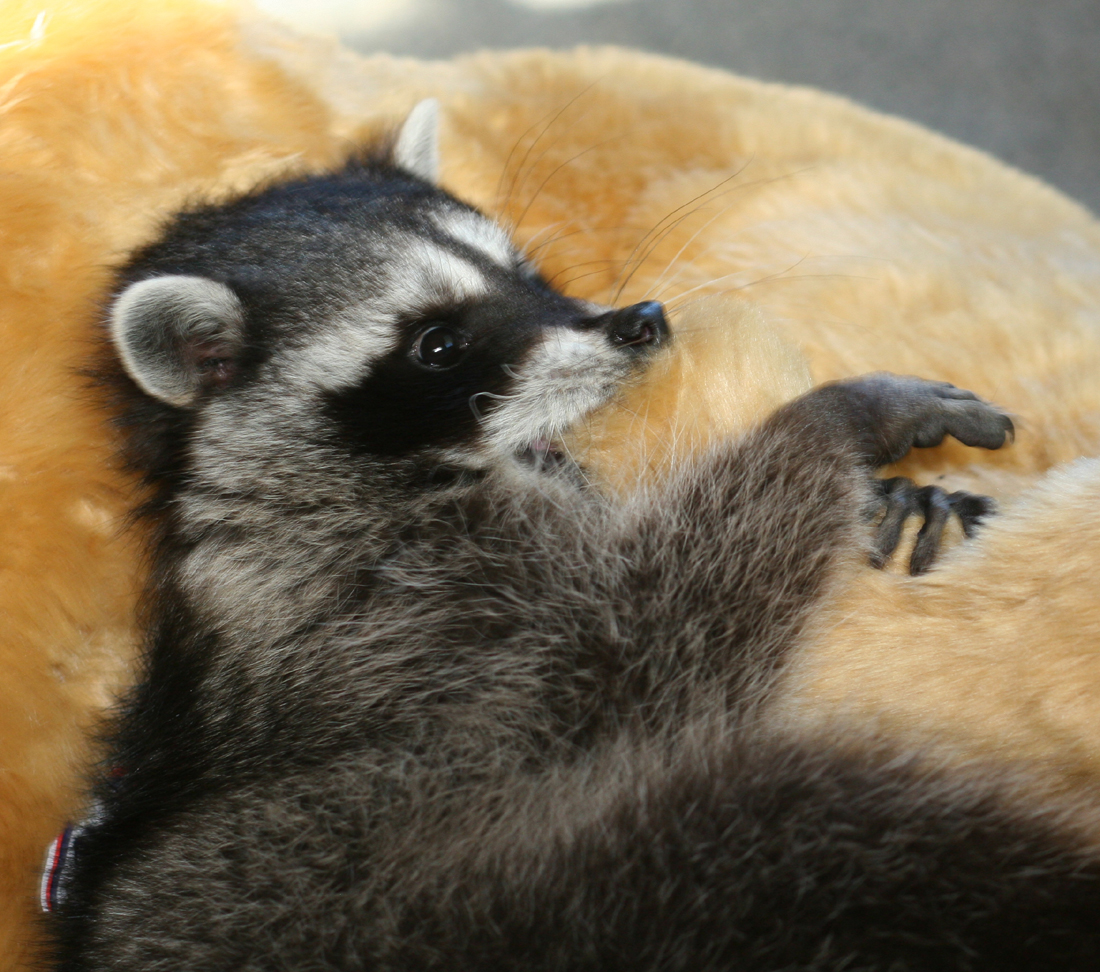
It is winter so we did not get to play in the pond, which is too bad since tigers are one of the few cats that enjoy water, and I would really like to play with him in the water… We did play in the bathtub a few times. (Of course the raccoon likes to bob for mussels and carrots in that bathtub, and was not sure a tiger was the best partner for that activity!) We did get a little time outdoors when the weather was reasonably nice:
At first blush, Titan was NOT impressed with the idea of a canine buddy. He had surprisingly strong prey drive for his age (even for a tiger!), so I decided to start by introducing him to a calm but large dog whom he could not possibly perceive as a snack. First I played with Titan for a good while so he was not too rambunctious, then I fed him a meal so he was not too hungry or cranky, and then I brought Ansel into the room while Titan was in his crate, and let them sniff for a little while before I opened the crate door. Titan came out, looked at Ansel, and hissed loudly. He then lay on his back, but let out a loud staccato roar. Ansel was impressed and left the room… I will not bore you with all the details, but I worked on this for the next couple of days, and now Titan loves all the dogs, including Ansel, and spends several hours a day wrestling and playing with them:
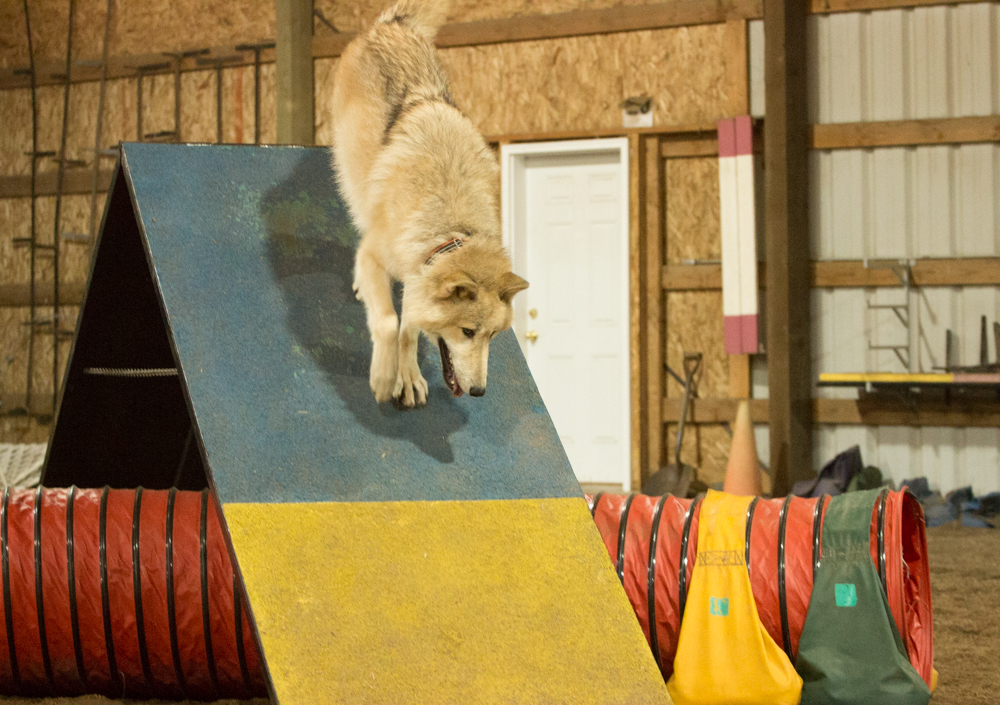
Because it was drizzly outdoors, we spent most of our time indoors, playing, training, eating, napping, working on agility, generally suffering the misery of captivity. We took Titan as one of the demo animals for a seminar on craniosacral osteopathy which is a great opportunity for socializing, and he played with lots of people and animals:
Titan is on his way now to a new home. He is a wonderful tiger, and we will miss him greatly.
“Do exotic animals make good pets?” is one of the most common sentences I hear, often with the words
“exotic animals” replaced with a particular animal, and there is never a good answer because it is the wrong question! There is broad array of animals and an even broader array of human preferences, so the right question is, “Would this particular type of animal make a good pet for me right now?”
Let me clarify this with a metaphor: Is a Ferrari a good car? If you are looking for a reliable vehicle that gets good gas mileage, has low cost of ownership, and can transport your children to soccer practice, NO! If you are looking for a safe vehicle for your reckless 17 year old son, NO! If you are looking for a beautiful Italian sports car that goes very fast and impresses the ladies, YES! Is a Ferrari dangerous? That depends entirely on the driver. Most people should not get a Ferrari, but for those who should it is a perfect choice. Same thing with any animal, domestic, wild, or exotic—if the particular animal fits into your lifestyle and you understand and accept the compromises required to care for that animal, you can have a wonderful and safe experience that is deeply rewarding for both you and the animal. If you do not fully understand what you are getting into, there is a high likelihood that both you and the animal will be miserable…
Speak candidly with as many people as possible who have experience with the animal you are considering, and gather as much information as you can about the pros and cons of the animal. Be honest with them about your lifestyle, personality, and concerns, and listen carefully to everything they say. Spend some time around a few animals that are similar to what you are considering, and not only for a few minutes on their best behavior—offer to help clean cages, give them a bath, babysit for a weekend, whatever you can do to really understand what life with this animal is like. Once you understand the negatives, you need to do three things carefully:
1. Envision the worst case scenario. You will likely do better than the worst case, but maybe not, so be prepared! Listen to all the negatives and imagine that you get an animal that does ALL of the worst things you hear. Think about these negatives in the context of your preferences—are you tidy, quiet, like to sleep late, squeamish about feeding certain things, etc. Will you still be happy with that animal?
2. Really, carefully imagine what those negatives mean over the lifetime of the animal. It is easy to say that you do not mind being kept up overnight by noise, but by year seven you may not feel the same way. It is easy to say you do not mind odor, or cleaning up many times per day, or having your couch chewed up, but imagine how you will feel when you have been living with that negative for years. When I got a crow, I was warned that they poop lots. Big deal, I have plenty of animals that poop lots… But a few years later, it IS a big deal. I change my shirt 10 times every day, and mop the floor and wipe the couch and clean the wall and the seats in the car… How will you feel about those negative later if you get married or have children? How will you feel when you cannot go on vacation because you cannot find anyone to watch your animal? Genuinely and carefully think about this…
3. Research the laws and regulations concerning the animal you want to own. Federal, state, county, city, etc. Make sure that you understand the rules so you do not risk yourself or your animal by breaking them.
All of these issues should be exactly the same whether you are getting a goldfish, cat, dog, monkey, wolf, or lion. If you go through these steps and are certain that you are prepared to live with the animal for its lifetime and make the requisite compromises, then you and the animal will likely have a wonderful experience. Do as much research as possible, find a responsible breeder who has great animals and will give you support, get everything set up, and go for it! But if you are at all unsure, take more time to think about it: this is an important decision that will impact you and the animal for many years to come…


Recent Comments