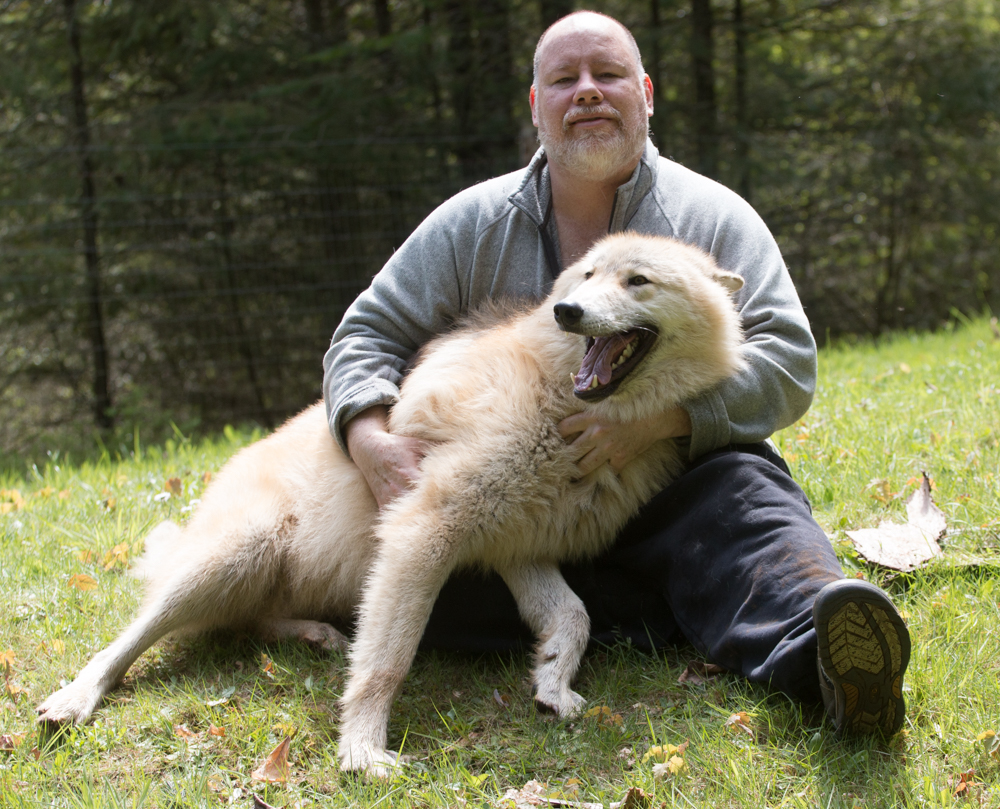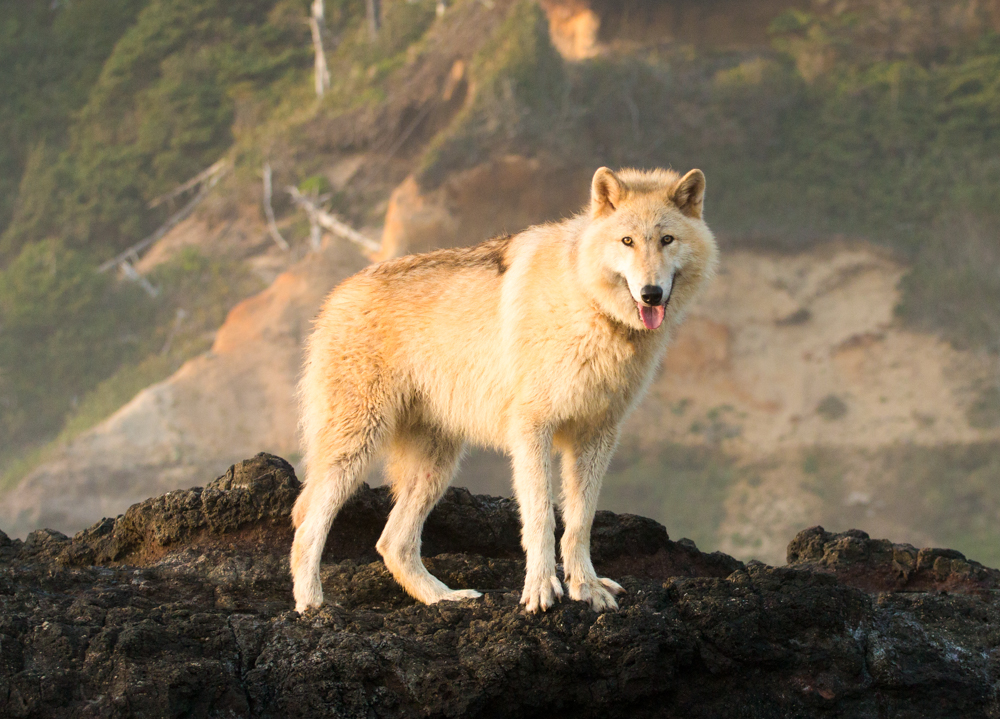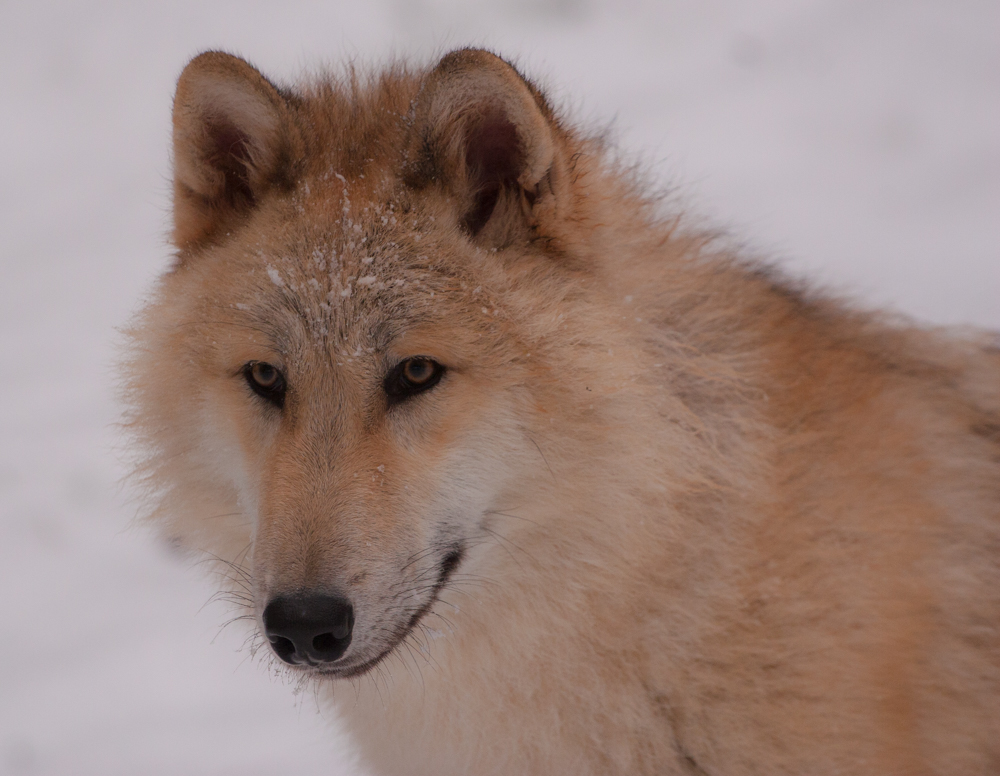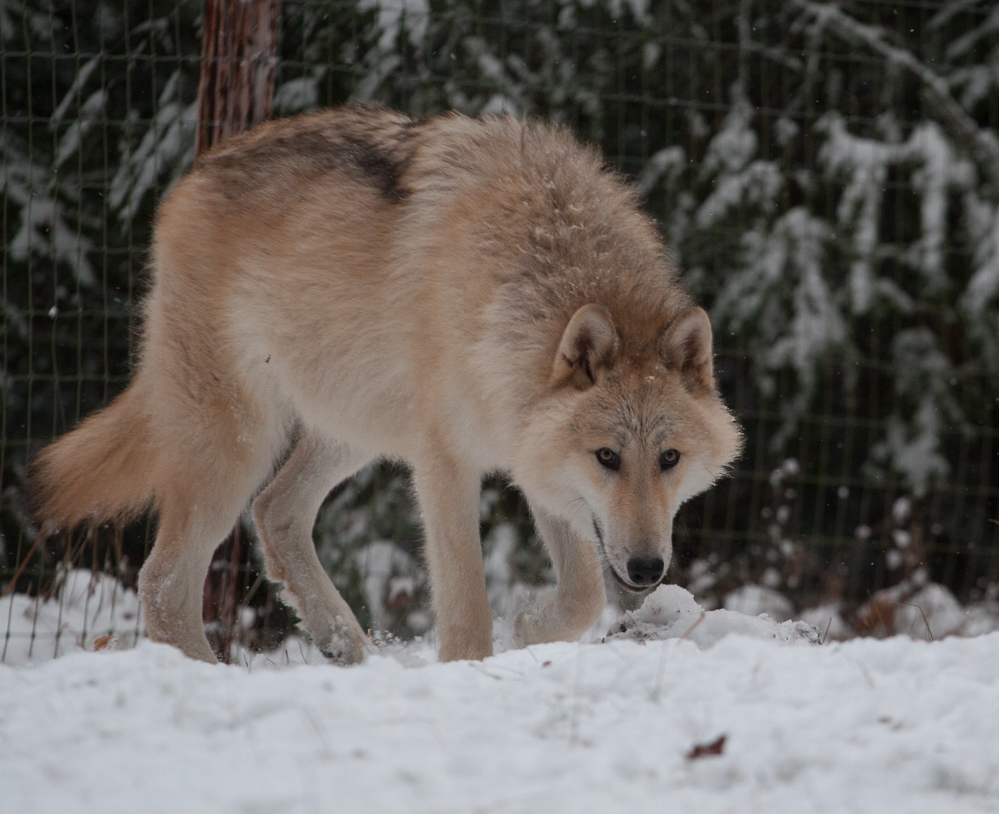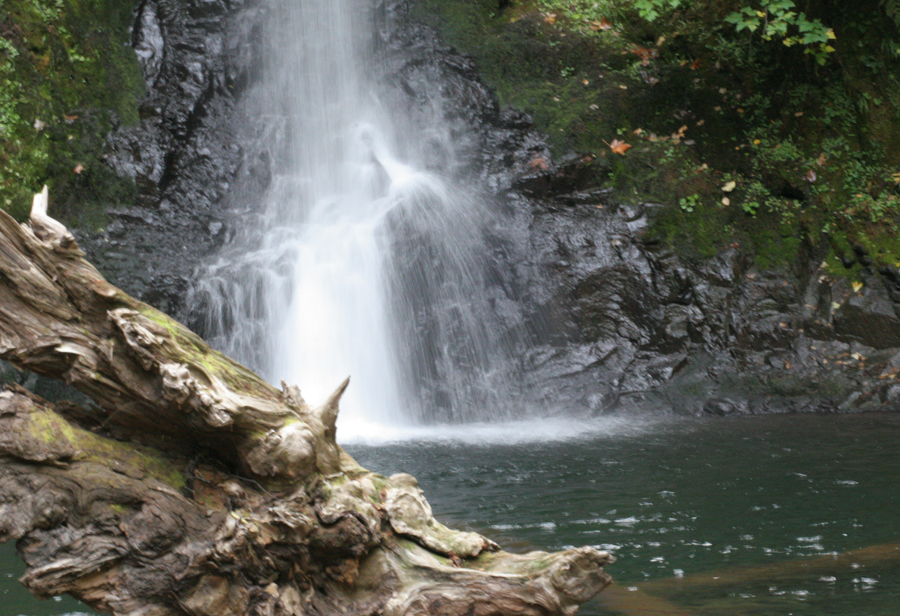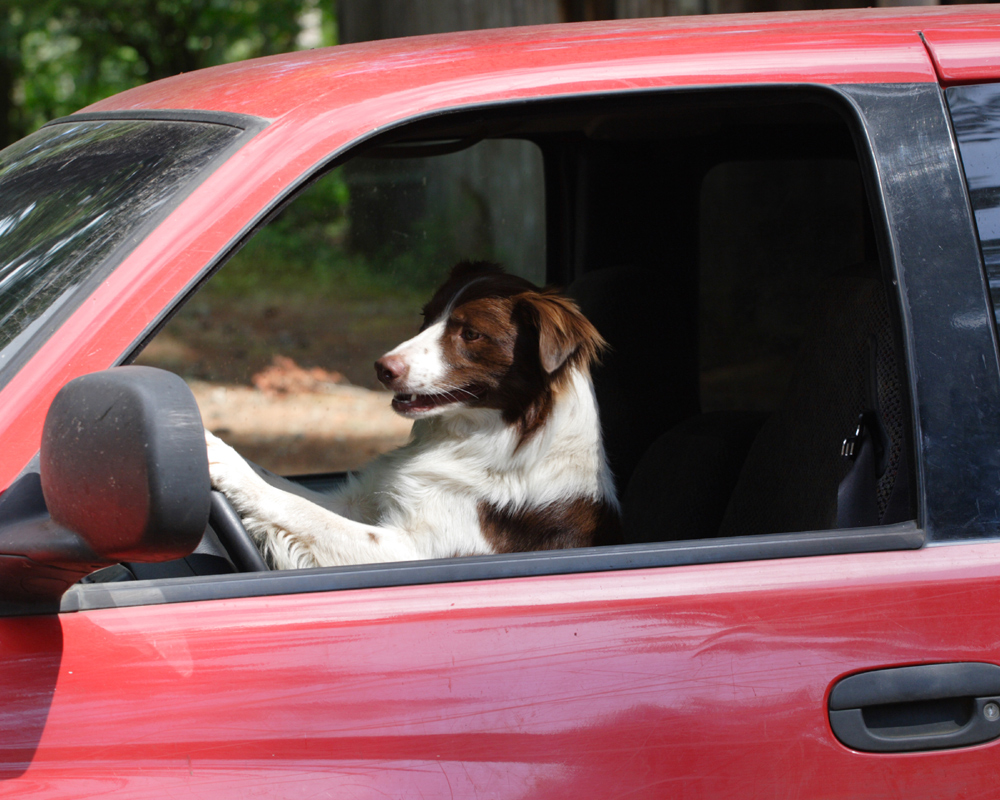
For those who met Titan while he was staying with us, or watched his videos on this blog, here is a picture of him in his new home. He is doing great and has remained the sweetest and happiest tiger imaginable. He has a nice enclosure and a great pond, but nothing beats a nice swim in the pool on a warm summer day:
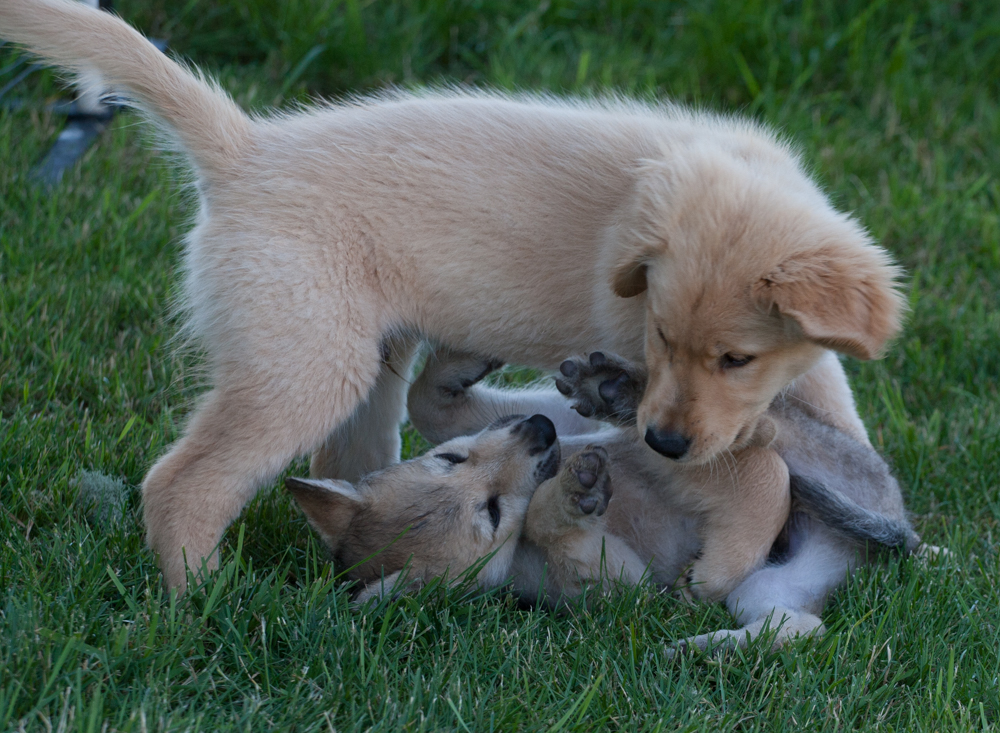
It is difficult to believe that ten years have passed since we raised the “Litter of the Law.”
We put together video and photos of a few highlights of their lives so far, and thought some of you might enjoy seeing it. It is simultaneously too long and too short, as it is difficult to capture ten years of the lives of eleven puppies without making a very, very long movie…
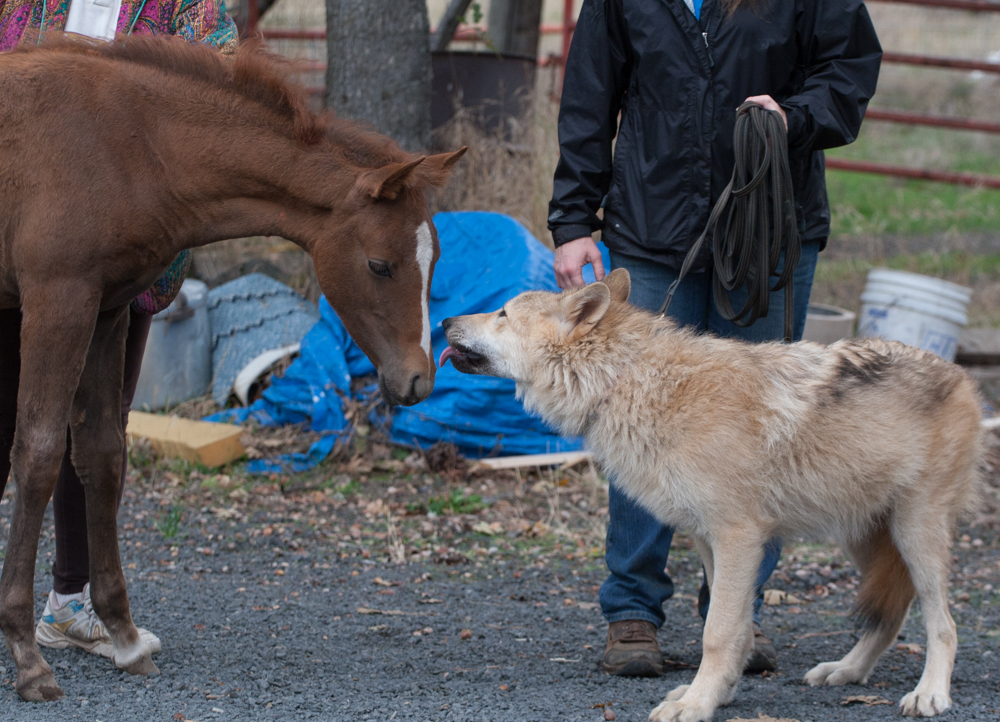
We have been caring for a young Bengal tiger named Titan. He was 8 weeks old and 15 pounds when he arrived, and around 22 pounds eight days later. He has around 500 pounds still to gain. He is on his way to a new and exciting life, and is here for some additional socialization. We are quite fortunate to have some wonderful colleagues who sometimes send animals here which allows us to keep learning and experiencing new individuals, and benefits the animals by exposing them to new experiences with trainers who are good at showing them that the world is a wonderful place. While with us, Titan will get to meet a wide variety of “other” animals and have different experiences. One aspect of training animals for film is that a wide variety of animals either live here or have visited, so all of our animals are quite welcoming towards visiting creatures. Last summer we had a baby camel in the kitchen and I opened the door to let the dogs say hello, and they walked right past her as though a camel in the kitchen was utterly expected…
I thought it might be interesting to share a few observations and images of his stay. Of course, this post will be mostly video since I am pretty sure most people would rather watch a tiger than read my observations!
Anytime you are raising an animal that will grow up to be easily capable of killing a human, the question of bite inhibition and boundaries becomes critical. If you raise a dog or cat that mouths too hard, jumps up, or is a little headstrong, it is not the end of the world. A lion, tiger, or grizzly that has those traits is very different. Not only is it dangerous, but it ends up having a much less rich life than it could have because it cannot be safely handled. At the same time, the process is slightly complicated because they are not domestic and are far less eager to please or willing to concede leadership. This makes for an interesting balance: you want to avoid conflict but at the same time you need situations to
reinforce that you are the leader. I find that some people are far too permissive, and the animal learns that they can do whatever they want, and other people are far too proscriptive and the animal is essentially being told “no” all the time. I really try to set situations up where there are many obvious paths to success, so there are few rules, but then be absolutely clear about those rules. I also start right away by teaching a fun and positive game that is easy and gets a reward—usually put your feet on a mark. I make this a super fun game, so anytime the animal wants to do something I do not want I can tell him to go to the mark and suddenly he has a clear path to success.
Titan is an absolute gentleman about his bottle. He is good about keeping his feet on the ground, and if he does put a paw on you he is very gentle and keeps his claws retracted. At this point he is consuming both milk in a bottle and meat in a bowl. If anyone is curious, the milk is a combination of goats’ milk, Esbilac, vitamins, amino acids, probiotics, etc. And the meat is primarily turkey for now, along with some liver and other organ meats.
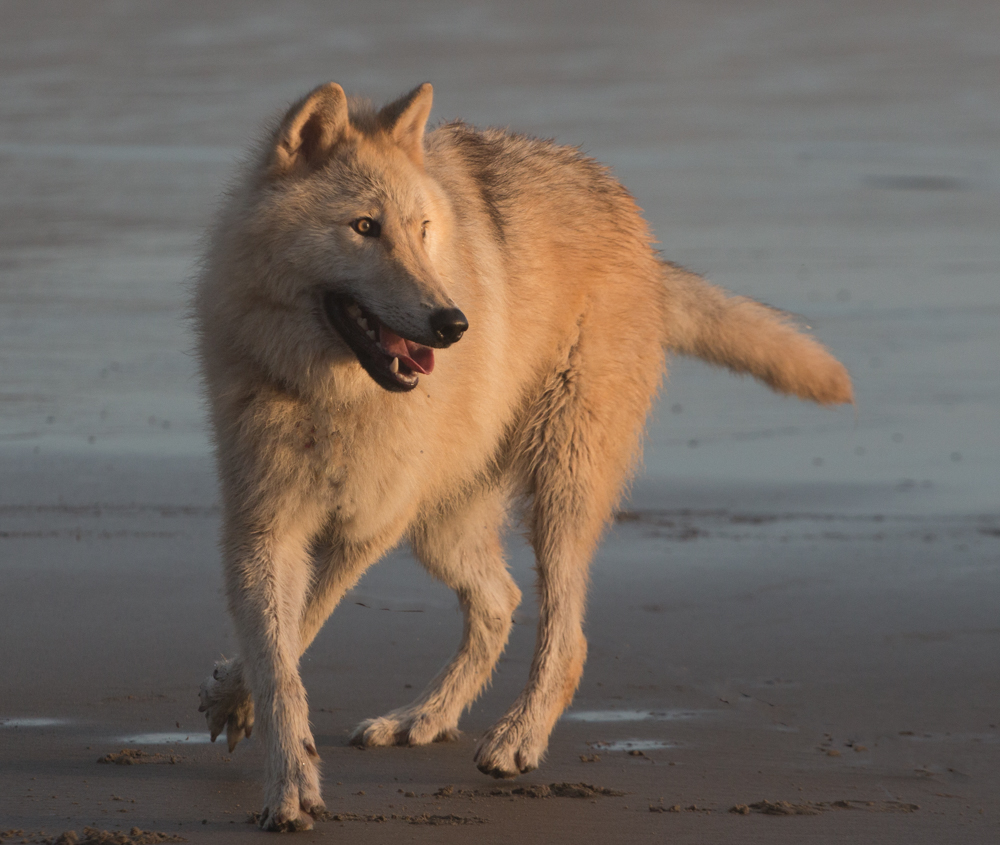
It is winter so we did not get to play in the pond, which is too bad since tigers are one of the few cats that enjoy water, and I would really like to play with him in the water… We did play in the bathtub a few times. (Of course the raccoon likes to bob for mussels and carrots in that bathtub, and was not sure a tiger was the best partner for that activity!) We did get a little time outdoors when the weather was reasonably nice:
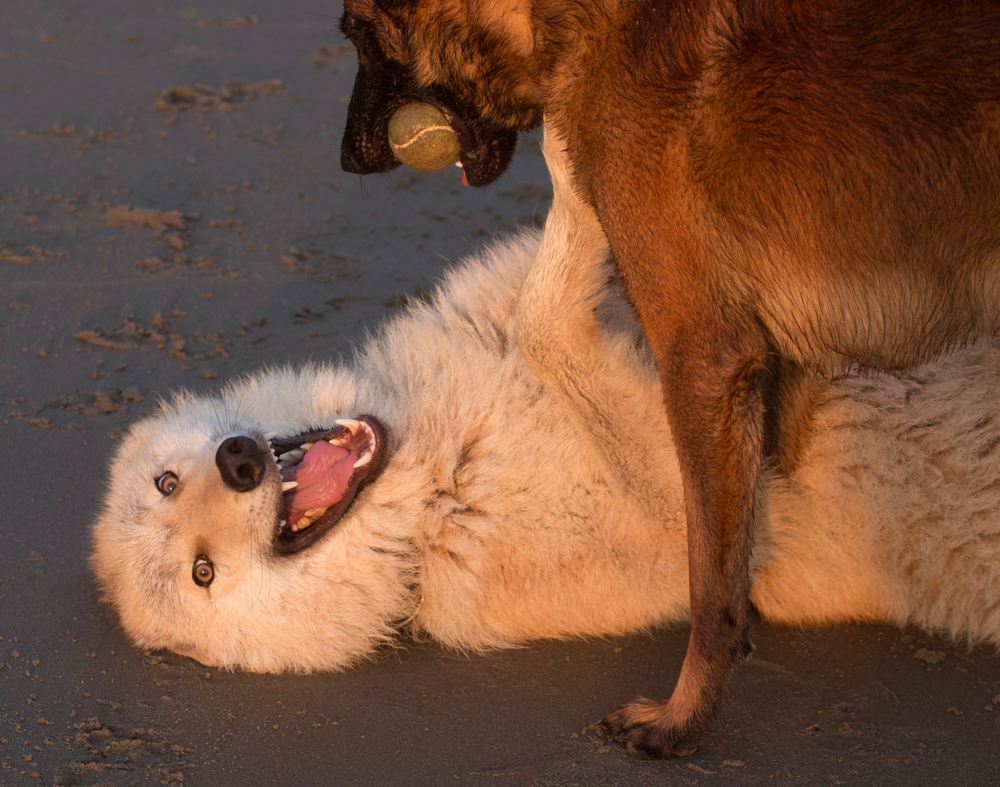
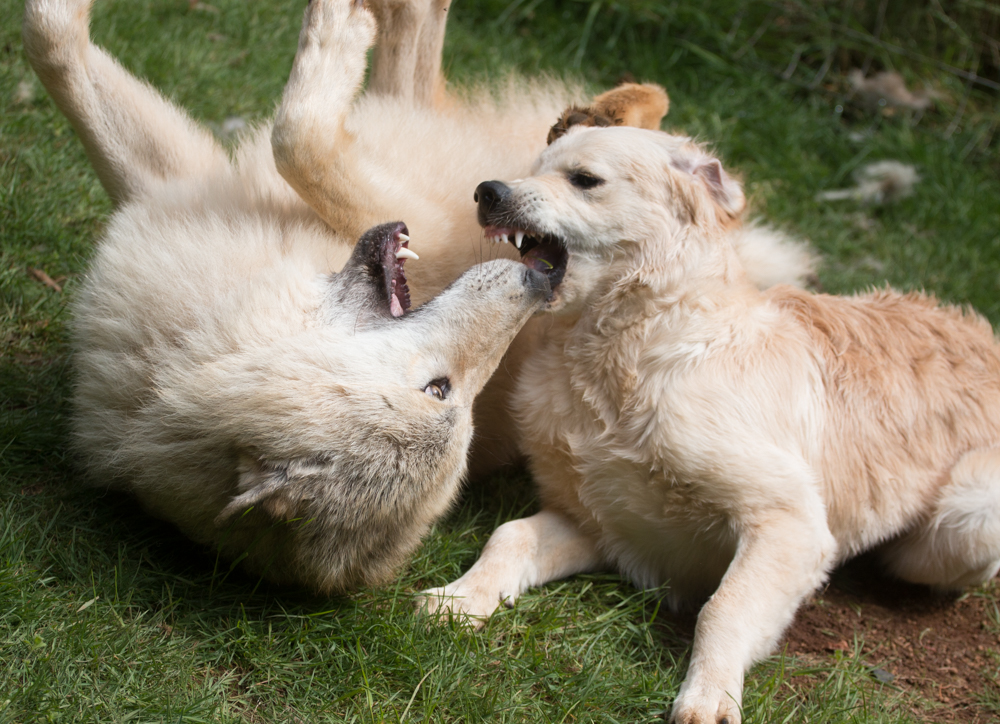
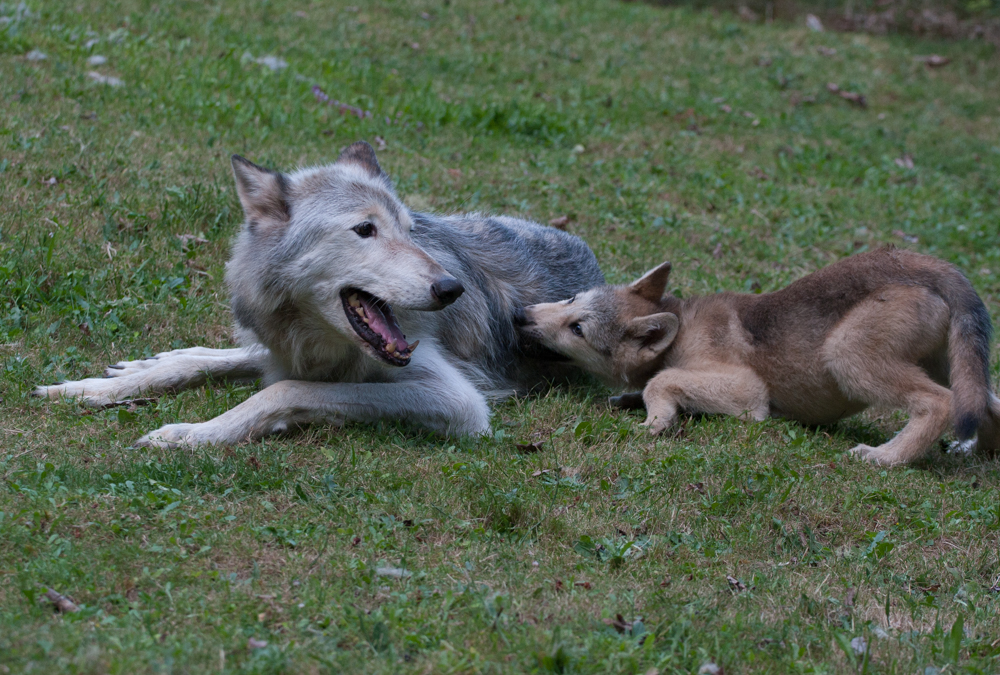
At first blush, Titan was NOT impressed with the idea of a canine buddy. He had surprisingly strong prey drive for his age (even for a tiger!), so I decided to start by introducing him to a calm but large dog whom he could not possibly perceive as a snack. First I played with Titan for a good while so he was not too rambunctious, then I fed him a meal so he was not too hungry or cranky, and then I brought Ansel into the room while Titan was in his crate, and let them sniff for a little while before I opened the crate door. Titan came out, looked at Ansel, and hissed loudly. He then lay on his back, but let out a loud staccato roar. Ansel was impressed and left the room… I will not bore you with all the details, but I worked on this for the next couple of days, and now Titan loves all the dogs, including Ansel, and spends several hours a day wrestling and playing with them:
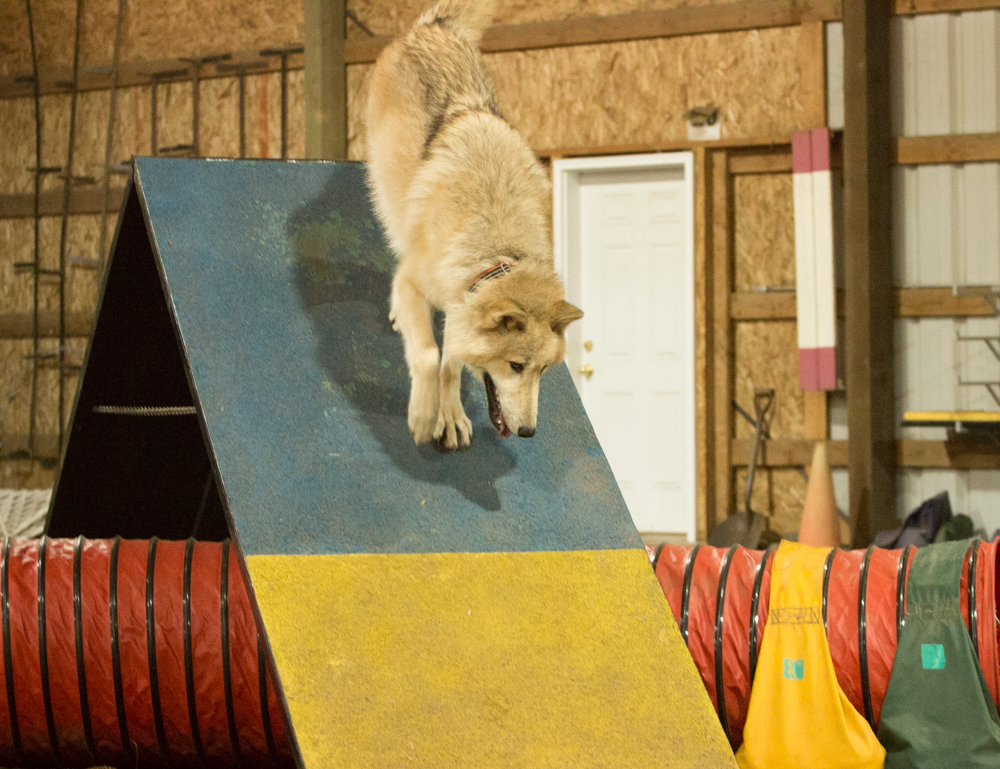
Because it was drizzly outdoors, we spent most of our time indoors, playing, training, eating, napping, working on agility, generally suffering the misery of captivity. We took Titan as one of the demo animals for a seminar on craniosacral osteopathy which is a great opportunity for socializing, and he played with lots of people and animals:
Titan is on his way now to a new home. He is a wonderful tiger, and we will miss him greatly.
Many, many years ago, my young Newfoundland Tillie and I were hiking down the Rio Grande near Santa Fe, several miles from the nearest road. It was one of those perfect days where the sun seems to warm every inch of your body while a gentle breeze keeps you cool, and the concerns of life seem far away indeed. Tillie was trotting a few yards ahead of me, off-leash, when my reverie was shattered… 
Have you ever heard the screech of tires coming toward you? The sound of failing metal brakes struggling to stop a freight train about to impact your car? The sound of millions of voices crying out in terror and suddenly silenced? A high power electrical transformer exploding? The clattering chain dragging your roller-coaster car towards the looming brink? Imagine them all combined into one piercing-deafening-heart-stopping-shriek-of-a-rattle. Even if you have never heard that sound, there is an ancestral memory woven deep in your genes that tells every fiber in your body and soul to contract. I froze and called Tillie to me, and she happily trotted over, apparently unconcerned by the deathly sound. Inches from where she had been I saw the largest, angriest rattlesnake that has ever lived. Normally I love snakes, and gently remind people that they are an integral part of nature that will not hurt us if we leave them alone, but standing there, feeling how close Tillie had been to death, I was less benevolent and rather more terrified. I could almost see the poison dripping from his fangs and eyes, as I returned his icy stare. Tillie and I retreated a few feet, and I held her closely as she licked me with an “I have no idea why you are suddenly hugging me, but okay…” look on her face…
After a few minutes I was calm and began trying to figure out a way around the giant serpent who filled the only available trail. I tried various methods to encourage him to depart, all to no avail. Finally, anxious to get to our favorite swimming spot, I hatched a plan. (Have you noticed that plans that are “hatched” almost always end badly…) I put Tillie in a down-stay and found a long, hefty stick with a sort of a “Y” on the end, and I cautiously but swiftly scooped the snake with the stick and flung him into the river.
Of course, what Tillie saw was me carefully selecting a lovely fetching stick, as I had done many times, and flinging THAT into the river. And so, before I could utter a word, she was up, into the river and swimming powerfully towards the western-diamondback-stick which was swimming towards me with astonishing rapidity. For the second time in 5 minutes my heart leapt into my mouth and I tried to call her back but she either could not hear over the river or perhaps figured she would come just as soon as she had the stick in her mouth. Fortunately, I still had the real stick in my hand, and in a moment of clarity decided to fling it between Tillie and the snake. She grabbed the closer stick, turned, and came back to me… Ever since then I have proofed stays and recalls rather more creatively and diligently!
Sometimes in training we seek not only to teach a new behavior, but also to modify an animal’s mental state. Often this can be achieved simply by choosing to reward the animal only when it is in the desired state–reward when the dog is working calmly, or when the dog is happy and enthusiastic. This is one significant difference between advanced dog training and novice dog training: beginners think in terms of teaching a behavior, advanced trainers think in terms of shaping attitudes. It is straightforward
to train a dog to walk at your left side, the elegance lies in training a dog to do so with enthusiasm and joy.
I still remember how badly I messed this up with my first trained dog, many years ago-Tillie was an exuberant Newfoundland, and I was an easily embarrassed teenager. On our first night in obedience class, Tillie seemed to me to be the least-well-behaved puppy there, barking and dragging me around, and I resolved not to look like a fool the next week. So before the next class I took her on a huge hike: we climbed mountains and swam rivers and ran in sand and chased balls, and by the time we went to class she was happily exhausted. She calmly walked behind me at a glacial pace, and I felt that we had made great progress. For the next 10 weeks, every Thursday I repeated this routine, and never again was Tillie hyper in obedience class… A year later I decided it was time to try our hands at competition obedience, so I entered another class, and discovered that my bright, energetic, happy dog turned into a slug the moment I started doing obedience. She lagged behind, and did everything slowly and without any enthusiasm. It took me a while to realize that I had trained her to be that way… I had actually conditioned her psyche to enter into a particular state whenever certain cues were presented.
One particular situation where training mental state can be extremely beneficial is with a dog who gets too stimulated. Whether it is when another dog approaches, or during play, or when the doorbell rings-if your dog reacts with excess energy, you face the challenge of not only modifying the behavior, but also modifying the underlying excitation. One of the best techniques for this is training your dog to “cap” its own emotional response with an incompatible behavior before an undesired outcome. This morning, one of my dogs did a lovely job of illustrating that principle, and I thought I would share it:
Sequel is a young border collie rescue. He is very intelligent, but even more than most border collies, he has some behavioral quirks. Primarily they all center on a tendency to become over-stimulated rather easily. That tendency is present in his littermates, and is quite extreme, despite considerable work on reducing both the underlying causes and the specific manifestations. He sleeps right next to me in bed, and while he is an excellent sleeper, he tends to wake with much exuberance when the alarm goes off, which leads to his jumping on my head and then escalating frantic and annoying behaviors until I get up and take him outside to play. (I on the other hand wake grudgingly, and try desperately to hide under the covers.)
Knowing that one day while half asleep I might fling Sequel out the window, I decided that I should find a remedy. Given that I would be largely asleep, the solution needed to be fairly simple. So I put a large fabric crate in the room with the door permanently open and a comfy bed inside, and every morning when he jumped on my head I sent him into the crate and told him to wait there. I then waited for him to settle back down, and once he was relaxed I got up and took him outside.

He easily and effectively learned this, and for 6 months we had this routine-he sleeps soundly until the first noise, then wakes, gets excited, gets sent to lie in his crate, we both snooze for 10 minutes, then we get up.
Today, the phone rang early, and Sequel stood up, looked at me, stretched, hopped off the bed, went into the crate, and lay down and immediately went back to sleep while I talked on the phone.
On first blush this seems trivial-big deal, the dog learned to go into a crate. But look more closely. What is interesting about this is not that Sequel learned to go into a crate-he learned that perfectly within a day or two and did it reliably every morning. It is not even that he learned to go into the crate without my telling him. What changed this morning was that he stretched, did the behavior, and went back to sleep. He never got excited! An autonomic response changed. He would normally have had a surge of endorphins at that point, and would have sprinted into his crate and obediently waited. What was different was not that he did what I wanted, he always did what I wanted, it was that his nervous system actually skipped the excitation phase of the process. The crate behavior was an operantly conditioned, trained, behavior, but through enough repetitions, Sequel became classically conditioned to have a different emotional response.

We got a call for a project that needed an antelope lifting his head suddenly on cue. Easy enough… 
But they had previously hired another company who had failed because getting to the studio required riding in an elevator and the antelope would not get on the elevator. According to the producer who called us, they had tried to push and pull their antelope onto the elevator, and he had bucked, kicked, flailed, and generally had a frightening fit! The producer was understandably very concerned that the same thing not happen again because they had wasted a LOT of money that day having the entire crew waiting…
I said, “No worries, we need a week to train.” He argued that it was a really easy scene, and I explained that the week was to train him to enjoy the elevator, and that I would not take the job with less.
I got the job, and for the next five days we took our antelope to town to play on elevators. For the entire first day we never asked him to get on an elevator, but he got treats and praise for approaching the elevator and had a great time, and we practiced walking him over a piece of carpeting in a doorway. We moved his feet all over and around the elevator entrance and released pressure whenever he got near to the elevator. The second day he learned to trot into the elevator over the same piece of carpet and right back out. The third day the door closed and then opened right away, etc… By the end of the week he was leading perfectly onto several different elevators and happily riding up and down, and a lot of people thought we were crazy…
We went to the soundstage the next week, where we met with the producer and went up to the studio. Of course, Gamble led onto the elevator and rode perfectly and walked into the studio and nailed the shot. The man smirked at me and said, “I can’t believe you charged me for a week of training when obviously your antelope has no problem riding the elevator.”
I tried and tried to explain to him that IF I had shown up the week before and attempted to force Gamble onto the elevator he would have behaved exactly as the other animal did, but no amount of arguing would convince him. I had taken some video of the prep, so I could have shown him the hours of work, but at no point during the prep did we try to force Gamble, so there was never a confrontation, never a moment that looked like there was a problem, never a moment in which Gamble was not having a good time. Because, as in most animal training, the best path to success was for me to be smart enough to manipulate the situation so that Gamble was able to succeed without ever really knowing that there was even an issue.
If we do our jobs well as animal trainers, it creates the absolutely untrue illusion that we are doing nothing–animal trainers generally only look like heroes when they have allowed something to fail and then appear to be saving the day…
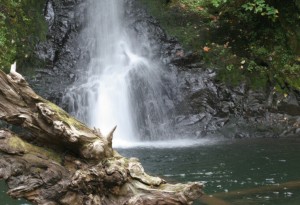
Lauren and I took several dogs for a hike to the waterfall and a lovely picnic. Saga had a scene to film the next day, and we did not want him to get too tired on the long hike, so we left him home, but promised to take him for a walk when we got back. It was one of those perfect spring days where time seems to slow down, and we lounged in the sun, ate sandwiches, and threw sticks into the swimming hole for Flint. A few hours later we trekked home.
We were at the top of the hill, about a thousand feet from our house, when we began to hear a strange noise. An airplane? No. A car? No. We started walking a little more quickly, and with each step the sound grew louder. We could not identify it, but we knew it was wrong, and we knew it was coming from the house. We were running now, breathless. We burst out of the woods and stopped short. What we saw did not make any more sense than what we had heard—something was pouring out of the cracks between the siding on the second story of our house, crashing to the earth. Water?? We ran to the front door and jerked it open.
Saga is field-bred Golden Retriever—he has swum in squalls in the Pacific, across the Willamette, and the Columbia. He lives to swim! But there, in our living room, he perched on top of our couch as the surrounding waters quickly rose. The ceiling was raining, hard, a river flowed down the stairs, and out of the corner of my eye I am certain I saw several broomsticks carrying buckets…
I sloshed upstairs and found that the water supply to one of the toilets had been ripped loose and had apparently been filling the house for hours. As best we can tell, a tennis ball rolled behind the toilet, and Saga had to get it, and his collar caught on the pipe and when he jerked to get loose the pipe snapped.
That is the last time we ever left Saga home when we took the others swimming…

There is a conceptual fallacy that has existed for many years but seems to have recently increased in popularity. It is the notion of the bad puppy: my puppy is so bad he ate my favorite shoe, knocked over grandma, chewed through a wall, dug up the yard, destroyed a pillow, drug a table around, pooped in a museum, chased a cat, jumped out a second story window, knocked a window out of my car, humped a pillow, got mud on my shirt on my way to work, got out of the fence, got on the counter, stole the steaks, released the parking brake, set the curtains on fire, peed on my bed…
Let me share a slightly painful insight with you—these are not bad puppies, they are just puppies owned by idiots. The amount of trouble your puppy gets into is a measure of your IQ, not his mischievousness.
I know, it hurts and you want to deny it. Don’t. Believe me, whatever your puppy has done, I have seen it. My house has raised countless puppies of every variety, lions, hyenas, raccoons, crows, lemurs, antelope, skunks, wolves, coyotes, goats, chickens, rats, kinkajou, etc. I have seen things destroyed that you would not believe. I have seen my house flooded and my car’s interior completely destroyed, and I can honestly tell you it is almost always the owner’s fault…
If it seems like your puppy is more trouble than any other puppy, it simply means you are messing up more. You are failing to imagine the trouble he can get into, you are making mistakes. Sure, some puppies have more energy or are more destructive, but they all follow the same immutable laws of nature. They chew, they dig, they run, they jump, they climb, and they get into exactly as much trouble as you allow, no less and no more.
Don’t feel too bad about this. One of the many gifts your puppy will give you is humility. He will remind you that for all your vaunted higher reasoning skills, your thumbs, your speech and writing skills, you can still be outwitted by a ten week old puppy with boundless energy…
In February, Pat Patrick and Emily Dennis were arrested on charges of dog fighting. Ostensibly damning evidence was also seized—treadmills, antibiotics, etc. Their animals were rescued from their enclosures by the humane society and taken to be put in other small enclosures.
Numerous media stories talked about the glorious rescue of these dogs by the heroic humane society.
Over the next few months, virtually all of the dogs were killed by the humane society.
Nine months later, both defendants were acquitted because there was no compelling evidence that they had fought their dogs.
The day after Patrick and Dennis were acquitted, HSUS presented their 2008 Humane Law Enforcement Awards to the persons responsible for this raid.
I have no idea if these people were fighting their dogs or not. No idea if their dogs had good lives or not, and I am certainly not defending anything they may have done to harm the dogs.
What I do know is that the dogs were taken and killed before their owners even got to present their case in court. And no restitution was paid, no apology offered. Quite the contrary, awards were given out for those involved. And that simply terrifies me. That means the HSUS can raid anyone they want and seize their dogs. Their evidence could be something as specious as the fact that you spent thousands of dollars to purchase a treadmill to help exercise your beloved dogs. Sure, you may be proven innocent in the end, but your dogs will have been traumatized, over-vaccinated, hacked into, or just plain killed…


Recent Comments